MANOEUVERS
Reining is a western equestrian sport that tests a horse and rider team on their ability to correctly perform a pattern in the confines of a show arena. Each manoeuvre is meant to mimic the behaviours and skills a horse would
need on a cattle ranch in the American West. Each pattern contains specific manoeuvres that are individually scored. The horse and rider are scored on their performance of each manoeuvre and may be given extra points for flawless execution of a manoeuvre with a visible degree of difficulty.
“To rein a horse is not only to guide him, but also to control his every
movement. The best reined horse should be willingly guided or controlled
with little or no apparent resistance and dictated to completely.”
- Jim Willowghby NRHA HALL OF FAME INDUCTEE
SPINS
From a standstill, the horse spins 360 degrees in
place around its inside hind leg. A pattern requires
one set of spins in each direction.
Spins are judged on correctness, smoothness
and cadence. Speed adds to the degree of
difficulty and will improve the score. Horses must
stop the spin exactly as the pattern indicates
to avoid penalties.


CIRCLES
The horse must perform two types of circles at a lope:
large, fast circles and smaller, slow circles. The circles
should be perfectly round with a clear and visible
difference in transition of speed from the large,
fast to the small, slow and vice-versa.
SLIDING STOPS
The horse accelerates to a gallop and then suddenly
comes to a complete halt, planting it’s hind feet in the
footing and allowing it’s hind feet to slide several feet,
while continuing to let it’s front feet “walk” forward. The
back should be raised upward and hindquarters come
well underneath.in a cadenced and fluid movement.
The sliding stop is the signature maneuver in Reining.


ROLLBACK
The horse runs down the arena to a sliding stop and
then immediately, without hesitation, performs a
180 degree turn and proceeds back over its tracks in
a lope - all in a single continuous motion.
JUDGING
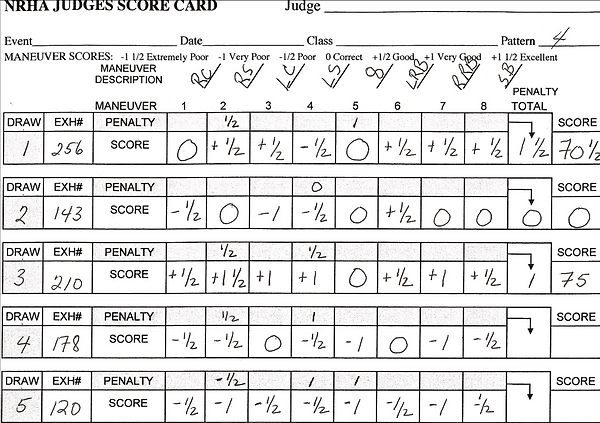
A horse and rider’s score starts at 70 points and can
increase or decrease based on the degree of difficulty
or how each maneuver is performed. Judges also deduct
points for penalties incurred throughout the pattern.
A complete list of penalties can be found in the
NRHA Handbook.